
Web design Nairobi: The complete guide to conversion-focused web design & digital marketing in Kenya
If you’re a marketing leader, CEO or business owner in Kenya, this guide explains how to plan, buy and run a conversion-focused website in Nairobi. It covers costs, timelines, platform choices (WordPress vs others), B2B conversion tactics, local SEO/AEO tips, example scenarios, and a ready-to-use FAQ schema + meta tags to drop into your CMS.
Mobile-first design, clear value proposition, trust signals and analytics-driven CRO are non-negotiable. For context, mobile and data use in Kenya is growing fast, design for mobile and fast loads first.
Kenya and Nairobi, in particular, is a testing ground for digital products in Africa. Smartphones, mobile money and local platforms mean users behave differently: fast, mobile-first, and payment-ready (M-Pesa and other platforms).
If your site isn’t fast on a cheap smartphone, or can’t accept local payment flows, you’ll lose customers before you get a second chance. Recent telecom and sector reports show rising mobile subscriptions and growing mobile data usage across Kenya.
Globally, WordPress remains the dominant website platform; nearly half of websites run on WordPress, which explains why many Nairobi agencies build on WordPress for flexibility and cost-efficiency.
If you want a maintainable, SEO-friendly site that integrates with local tools, WordPress is the default choice for most Kenyan businesses.
A B2B website that converts does three things immediately:
Explains value clearly (what you do, who you serve, and the outcome) in the hero area.
Builds trust fast (case studies, logos, security, clear contact channels).
Guides visitors to an obvious next step (book a demo, download a case study, call).
Design principles to action:
Mobile-first. design for thumb navigation and small screens first. Luke Wroblewski’s mobile-first philosophy still applies. Mobile forces the team to focus on the essentials.
Scannable copy. Jakob Nielsen’s research shows users scan, not read. Use concise headings, bullet lists and clear CTAs
Speed & reliability. Kenyan users often browse on mobile networks, fast hosting, image optimisation, and CDN matter.
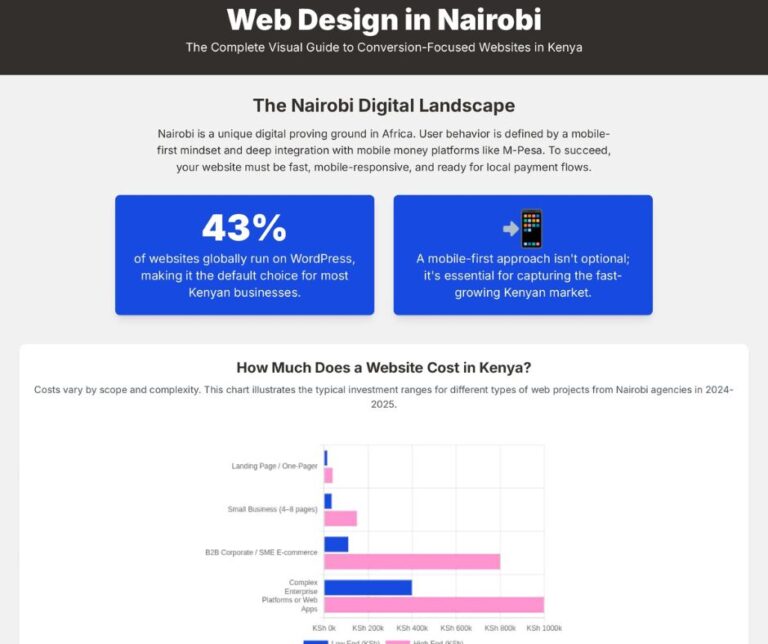
costs vary widely depending on scope. Expect a range, from a simple landing page at the very low end to enterprise B2B portals costing several million KES. Here are practical ranges used by Nairobi agencies (2024–2025 market references).
Landing page / one-pager: ~KSh 15,000 – 40,000 (design + domain + basic hosting)
Small business (4–8 pages): ~KSh 35,000 – 150,000 depending on bespoke design and content.
B2B corporate site / SME e-commerce: ~KSh 110,000 – 800,000 (custom design, integrations, forms, CRM sync, training).
Complex enterprise platforms or web apps: KSh 400,000+ (custom backend, heavy integrations, strict SLA and security).
What drives the price is basically the scope (number of templates), integrations (CRM, payment gateways like M-Pesa), custom development, content & copywriting, animations, legal/security needs, and post-launch support (SLA, monitoring, updates).
Project discovery & strategy: KSh 30,000–60,000
Design (desktop + mobile templates): KSh 60,000–120,000
Development (WordPress + plugins + CRM integration): KSh 80,000–150,000
Content & SEO setup: KSh 20,000–40,000
Hosting & maintenance (annual): KSh 6,000–60,000
We have also prepared a detailed and exhaustive post about the cost of corporate web design in Kenya in 2025. Click here to access the post.
From 2–12+ weeks depending on complexity.
Typical timelines:
Landing page- 1–2 weeks (fast turn)
Small brochure site (4–8 pages)- 3–6 weeks (discovery → design → development → deploy).
B2B corporate / e-commerce- 6–12 weeks (includes content, integrations, testing).
Large web apps / multi-month projects– 3–6 months or more.
Timelines from leading design resources and agencies show similar phase breakdowns: discovery (1–3 weeks), design (2–6 weeks), development (2–8 weeks), testing and launch (1–3 weeks). Build time shortens when the client has content and approvals ready.
Conversion is not magic, it’s engineering + psychology. Use this checklist below.
Message & trust
Single, obvious value proposition in the hero.
Social proof: client logos, short case study headlines, quantified results.
Security badges and privacy compliance (esp. if handling payments).
Friction reduction
Short forms (progressive profiling), one-click calendar booking, calendar + WhatsApp contact buttons.
Clear, consistent CTA buttons.
Performance & UX
Mobile-first layout, compressed images, lazy-loading, <3s initial load.
Logical content hierarchy — headlines, benefits, visuals.
Data & optimisation
Analytics and event tracking (Google Analytics 4 + server-side where possible).
Experimentation: A/B testing (headlines, CTA placement). HubSpot and Unbounce outline CRO tactics that work for B2B (lead magnets, gated resources, tailored landing pages).
Integration
Lead routing to CRM, automated email nurture, sales notifications (so team acts fast).
Pros: flexible, huge plugin ecosystem (WooCommerce, WPForms), local agency familiarity, easy handover. WordPress powers ~43% of websites (2025 figures), with a strong community and plugin support.
Cons: needs maintenance (updates, backups), plugins can bloat if misused.
Pros: rapid builds, less maintenance, visual editing.
Cons: exportability and complex integrations can be limited; costs scale with features.
Great for simple, payment-driven stores. For local payment flows (M-Pesa), plugins and gateway integrations vary confirm support before you commit.
If you need custom integrations and control → WordPress or a custom app.
If speed to market & low maintenance → Webflow/Wix.
For heavy transactions and marketplace features → consider custom development or Shopify + bespoke integrations.
To win both map/local and AI-answer snippets, do the following:
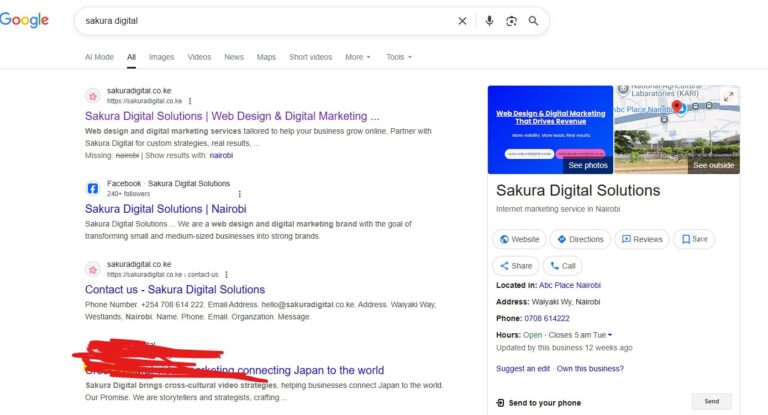
Create/claim your Google Business Profile and keep NAP (Name, Address, Phone) consistent on your site and directory listings (Yellow Pages, BrighterMonday, local chambers).
Add LocalBusiness/ProfessionalService schema and an About page with Nairobi landmarks and service areas.
Structure content to directly answer common queries with short definitive answers (FAQ blocks), then expand with supporting content and sources — AI engines scrape clear Q&A and FAQ schema.
Use schema types like FAQ Page, Web Page, and Local Business JSON-LD.
Use geo modifiers such as “recruitment services in Nairobi”, “legal services in Nairobi”, etc, naturally in headings, meta tags and slug.
Build locally relevant backlinks (Kenyan trade associations, local chambers, partner case studies).
Problem: Enterprise buyers need trust and compliance proof.
Solution: Landing page with hero value line “Reduce client onboarding time by 40%”; a downloadable whitepaper gated for lead capture; demo booking CTA; compliance badges and client logo strip; case study with quantified outcomes. Result: higher quality demo requests, shorter sales cycle.
Problem: Prospective students browse on mobiles and compare fees.
Solution: Clear program pages, fee calculator, chatbot for FAQs, and an application funnel with progress saving. Result: more completed applications and fewer abandoned forms.
Problem: High-value prospects want verification and quick contact.
Solution: Property listings with downloadable PDF spec sheets, video tours, and a “Book site visit” CTA that integrates with a calendar system and sales CRM.
These scenarios emphasize tailored user flows, not generic homepages.
Check your email inbox for the download link. If you can’t find it, check your spam folder.
Portfolio with B2B clients and case studies (show numbers).
Clear process: discovery, timelines, deliverables, revisions, and post-launch support.
Ownership & handover policy (who owns the code/content).
Ask for references and check them.
Vague scope or no written contract.
Promise of unrealistic SEO results (no guaranteed #1 rankings).
No plan for backups, security, or maintenance.
Problem: High-value prospects want verification and quick contact.
Solution: Property listings with downloadable PDF spec sheets, video tours, and a “Book site visit” CTA that integrates with a calendar system and sales CRM.
These scenarios emphasize tailored user flows, not generic homepages.








Landing pages from ~KSh 15k–40k; B2B corporate sites commonly KSh 110k–800k; enterprise custom solutions higher. Costs depend on integrations, content, and ongoing support.
2–12+ weeks depending on complexity. Faster when content/approvals are ready. Typical phase breakdowns align with standard agency timelines.
Clear value proposition, trust signals (case studies), frictionless contact paths, fast mobile experience, and data-driven CRO (A/B testing + analytics). HubSpot and other CRO leaders note that targeted landing pages and gated content improve B2B conversion rates.
For most Kenyan B2B/corporate sites the answer is yes. It’s flexible, popular among local agencies and well-supported. Confirm your agency builds secure, lightweight WordPress sites and provides maintenance.
If you transact locally, yes. M-Pesa integrations are common in Kenyan e-commerce and should be part of your requirements if you expect local payments.
Copyright © 2026 All Rights Reserved.